How to Find Reliable Bulk Edible Oil Suppliers?
Learn how to identify reliable bulk edible oil suppliers through quality benchmarks, compliance checks, infrastructure audits, pricing transparency, and supply stability—protect your margins and brand in the edible oil business.
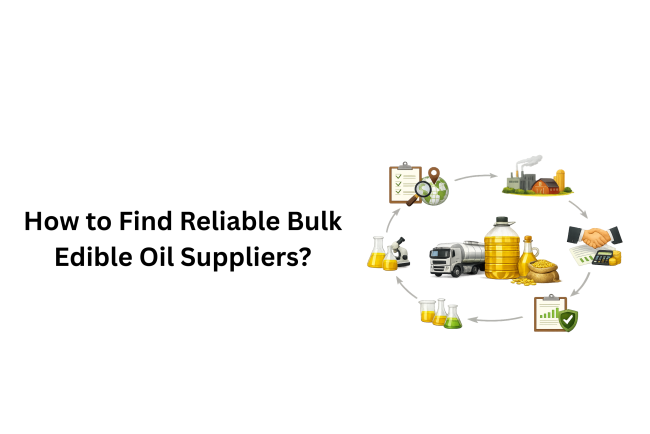
In the edible oil industry, one wrong supplier decision can quietly damage your margins for years. Adulteration cases, inconsistent quality, delayed shipments, and unstable pricing are not rare exceptions. They’re everyday risks.


If you are running or planning to enter the Edible Oil Business, supplier selection is not just a procurement task. It is a long-term strategic move. Your oil quality defines your brand reputation. Your landed cost defines your profitability. And your supply stability defines your ability to scale.
So the real question is not where to find suppliers. It is: How do you find reliable bulk edible oil suppliers you can actually trust?
Let’s break this down in a practical way.
1. Start With Clear Quality Benchmarks
Before you even approach suppliers, define your non-negotiables.
Reliable Bulk edible oil sourcing begins with internal clarity:
-
Required oil type (refined, filtered, cold-pressed)
-
FSSAI compliance
-
Lab testing standards
-
Moisture and impurity limits
-
Packaging format (tanker, drums, IBC)
Ask for:
-
COA (Certificate of Analysis)
-
Batch testing reports
-
Refinery details
-
Source origin documentation
A serious supplier will share these without hesitation. If documentation feels vague, that’s your early red flag.
2. Verify Infrastructure, Not Just Price
Low price is tempting. But in the Edible Oil Business, consistency matters more than short-term savings.
Evaluate:
-
Refining capacity
-
Storage infrastructure
-
Handling process
-
Transportation network
-
Quality control systems
Ask whether they:
-
Own refining units or act as traders
-
Have in-house testing labs
-
Maintain temperature-controlled storage
Reliable bulk edible oil suppliers invest in infrastructure. Traders working only on thin margins usually don’t.
3. Check Regulatory Compliance and Certifications
Compliance is not optional. It protects you legally and commercially.
Look for:
-
FSSAI registration
-
GST compliance
-
ISO certifications
-
HACCP compliance
-
Export certifications (if required)
In the Edible Oil Business, non-compliant sourcing can lead to product recalls, penalties, or worse—brand damage.
Always cross-verify licenses on government portals. Don’t rely only on PDFs shared on WhatsApp.
4. Ask for Samples and Test Independently
Never finalize a supplier without sample testing.
Even if the supplier provides lab reports, send samples to a third-party NABL-accredited lab. Test for:
-
Fatty acid profile
-
Peroxide value
-
Adulteration
-
Free fatty acid levels
Bulk edible oil quality can vary from batch to batch. One clean sample is not enough. Ask for multiple batch samples if possible.
5. Evaluate Supply Stability
Many businesses collapse not because of poor quality but because of inconsistent supply.
Ask these questions:
-
What is your monthly production capacity?
-
How do you manage raw material volatility?
-
Do you maintain a buffer stock?
-
What is your average dispatch turnaround time?
A strong supplier will discuss procurement cycles and risk mitigation openly.
In the Edible Oil Business, seasonality and import fluctuations affect availability. Your supplier should already have systems to manage that.
6. Review Their Market Reputation
Before signing any long-term contract:
-
Speak to existing buyers
-
Check online reviews
-
Look for past disputes.
-
Assess their market presence.
If possible, visit the facility. A physical audit tells you about more than 50 email exchanges.
7. Don’t Ignore Pricing Structure Transparency
Reliable bulk edible oil suppliers explain pricing clearly:
-
Base oil cost
-
Refining cost
-
Packaging cost
-
Freight
-
Taxes
Hidden charges usually surface later. Transparent costing reflects professional operations.
8. Build Long-Term Supplier Relationships
The best suppliers don’t behave like vendors. They act like partners.
In the Edible Oil Business, long-term contracts often lead to:
-
Better pricing stability
-
Priority dispatch
-
Credit flexibility
-
Advance production planning
If you’re still in the planning stage, this guide on how to can help you understand supplier selection from the foundation level.
Final Thoughts
Finding reliable bulk edible oil suppliers is not about online searches or the lowest quotations. It’s about due diligence.
It requires:
-
Technical verification
-
Compliance checks
-
Infrastructure audits
-
Reputation validation
-
Independent testing
In the Edible Oil Business, your supplier is your backbone. Choose carefully.
Because once your product reaches the market, customers won’t blame your supplier. They’ll blame your brand.
What's Your Reaction?